
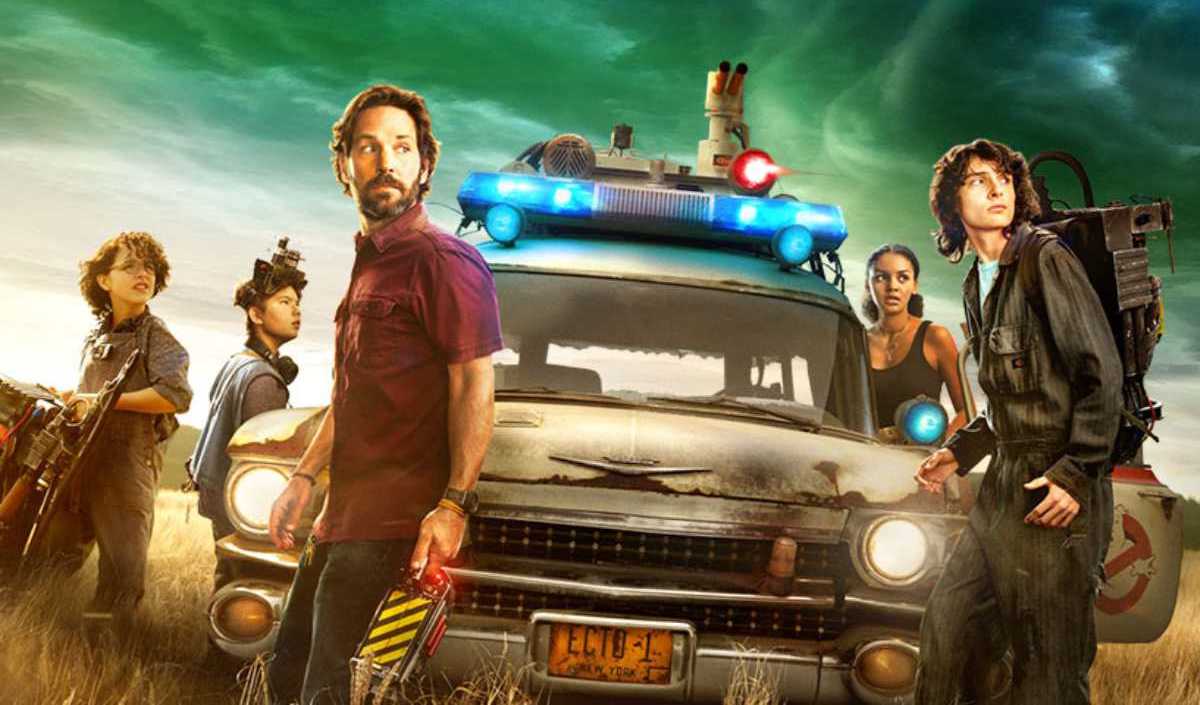
On Saturday, I took myself to see the new Ghostbusters film. I had some mild optimism for it given it was being directed by Jason Reitman, son of original film director, Ivan Reitman. As it turned out, Ivan also produced. The setup seemed positive.
The execution, however, I found, fell flat.
The film starts with an older Egon Spengler out in a farmhouse in the backend of nowhere. There is, respectfully, no speech during this opening scene and you never see the face of the actor portraying the late Harold Ramis. The premise is intriguing. He’s managed to catch something in a ghost trap then buries it beneath the floorboards. The sequence ends with Egon sitting in a rather familiar chair followed by a rather familiar set of limbs tearing through and taking him. To where, is unknown.
We move on to a seemingly typical family setup in American suburbia. Single mother. Two kids. Struggling with rent. The family are, particularly when we see McKenna Grace’s Phoebe, clearly belonging to Egon. The film tells the audience straight away when, somehow, Callie (played by Callie Coon) found out her dad passed away last week. But her father seemingly abandoned the family when she was a child so how did the lawyer dealing with Egon’s estate find out where she lived so soon? It’s a functional issue but it was the first thing that irked me.
Deviously defiant, Callie sees the opportunity to take 12-year old Phoebe and teenage son Trevor (Finn Wolfhard) away to her father’s house in the hope of being able to sell it and pay off her debt in a week. When they get to Summerville, they are greeted by Janine (Annie Potts as the first cameo) who reveals that her father’s house is worthless and that, he too, had trouble with mortgage payments so the only thing of financial value is the debt. As such, Callie decides running away from her financial problems and staying in Summerville is the best option. Quite how Janine knew when Egon’s estranged family were going to be showing up is a mystery that maybe even Jason Reitman can’t answer. But, anyway, just enjoy the fuzzy feeling of an original character showing up. She never appears again.
At this point, I agree with other reviews that the scenes in Summerville are some of the most interesting but also are ripped right out of Spielberg. For me, the shots and sets are very much like E.T. or Close Encounters.
This section takes time in splitting itself up into showing us more about the family. Trevor finds a pretty girl (Celeste O’Connor) at a roller-diner and is being put through various trials to prove himself.
Phoebe is at summer school where she meets Mr. Grooberson played by the ever likable Paul Rudd. We also meet Podcast (Logan Kim) who’s clearly meant to be the young version of Ray. He’s into making podcasts on the paranormal and spends a lot of time recording anything he finds of interest. Some of this is meant to be funny but it might have worked better if it was an adult doing it.
In school, Phoebe displays her unusual, for Summerville, intelligence which excites and intrigues Mr. Grooberson, a seismologist. Quite what a trained scientist is doing as a teacher at summer school is another one of those unexplained mysteries.
Podcast, in an attempt to woo Phoebe, takes her to the mines where they find carvings that look reminiscent of those in the original film as well as the skeleton of something.
Trevor, after not having been able to uncover the vehicle under the tarp earlier, has uncovered Ecto-1 and brings it to life, with a little help from grandpa. Not knowing what it is, he takes it out for a joyride in the fields. Nothing particularly special other than it nice seeing Ecto-1 out and in action.
In evening, Phoebe finds that a chess piece has moved. She moves hers and her opponent makes a move which results in her piece being tossed away. She doesn’t try to find it but, downstairs, she notices a PKE meter under the chair Egon last sat on. She picks up and, mysteriously, just solves the complex floorboard puzzle in order to unlock the hatch containing the ghost trap shown at the start of the film. This, she takes into school the next day where Mr. Grooberson begins educating her and Podcast on the Ghostbusters. Note that absolutely no one else in the class is the least bit interested in this very cool and dangerous looking piece of kit.
Anyway, Pheoebe and Mr. Grooberson bond over the seismic activity that’s been occuring daily in Summerville despite having no mining or frakking operations, fault lines, railways, etc. It’s odd and absolutely no one in the proceeding years has come out to investigate why because the script needs the 12-year old protagonist to just figure it out.
Cue an afterschool test of the ghost trap that can, apparently, be forced open just using crocodile clips hooked up to a school bus. Despite knowing what it is and what may be in it, Mr. Grooberson proceeds with the test and unleashes a ghost that heads to the Shandor Mine.
Meanwhile, Trevor’s been invited, luckily, by Lucky to the very same mine where his sister had been. Again, no one knows what the Shandor Mine is even though the film shows a lift shaft that descends deep into the mine. Not a single teenager in this scene admits to having gone in there because that would mess with the plot. Anyway, Trevor takes a look down the shaft and sees a ghostly monster look back. It fires through the shaft and no one is shocked or scared by this. All the kids laugh like it’s a damned firework.
We do get a touching scene where Phoebe, using the PKE meter, learns the identity of the entity she’s been playing chess with whilst looking around her grandfather’s barn. However, again, another mystery, when she sees the proton pack somehow she knows it’s a nuclear accelerator. It’s a unique piece of equipment designed by the Ghostbusters at great risk and Phoebe just knows what it is.
Another day. Another test. Phoebe takes the proton pack out for a spin with Podcast. This time, it’s Podcast who miraculously knows how to turn the thing on. After Phoebe melts the target of the test, we get, what must be, sounds of a masochistic ghost lurking in the nearby industrial unit.
It’s at this point that the film really starts to throw heaps of references on to the audience. Instead of Slimer being the first ghost the duo encounter, we get a similar one called Muncher because…he munches metal. Rather than slime those he wishes to attack, Muncher rapidly fires metal shards out. Amazingly, our pre-teen pain don’t get shot and die from the barrage of shrapnel that makes a modern machine gun look incompetent.
Cue the handily timely arrival of Trevor, now just strolling town in Ecto-1, and we have a trio of new Ghostbusters. Their first proper test is Muncher.
The ensuing chase had an opportunity for some gags on the generation gap. Three Gen Y kids trying operate Gen X tech. Digital trying to operate analogue. But, nope. The kids can drive the car, operate the gunner seat and handle the remote-controlled ghost trap with no problem. Ergo, Gen Y are just amazingly competent. In the real world, however, a lot of the current generation would be flustered on what to do with a control device that doesn’t have a screen. A missed opportunity.
Muncher is caught trying to head to the Shaldor Mine. On the way back, there is one spot of reality that our trio can’t escape. The law. They are pulled over by the sheriff who puts them in a jail cell for the night.
Phoebe demands her phone call. She gets it but she doesn’t call her mum. Instead, she unrolls a piece of paper with the number of the Ghostbusters she saw on Youtube earlier (yet, despite being on such a platfrom, the film chooses to have evryone not know who the Ghostbusters are) and dials. Who picks up? Ray Stantz. He must have paid a decent chunk to have that number diverted to his occult bookshop.
Anyway, the film enters a long expositionary dialogue between Phoebe and Ray where Ray willingly goes into detail about the collapse of the Ghostbusters. He explains that Egon dumped and ran with all their stuff going on about an impending apocalypse.
This scene brings up another curious point. Whilst the world may have been saved from ghosts, why didn’t the remaining three keep tabs on the paranormal activity? Surely, given what they’d fought off, it would be deeply irresponsible to just throw in the towel after two end-of-world events? And yet, the script has it that the team just disbanded and went and did their own thing. Had Jason Reitman been a bit smarter, he could have had the original team keep themselves incognito as they monitored things in the background, ready to take action when the world needed them again. This would have played better for the ending, I feel.
Callie and Mr. Grooberson, who we learn is called Gary, come and get the kids out of jail. Phoebe then proceeds to threaten the sheriff with the proton pack after a comment about Egon. That should have had her put back in the cell, but nope.
They get back home and the interpersonal conflict that follows shows the fractured nature of the relationship between Callie and Egon. With Phoebe now having found out what her grandfather was trying to do, she asks her mother what kind of scientist he was. Instead of responding maturely, Callie gives an emotionally charged response to her daughter highlighting just now deeply hurt Egon’s leaving was and how she’s never come to terms with not having her father around. Phoebe, armed with more knowledge, is upset and angered.
At Shaldor Mine, something has awoken.
Gary (Mr. Grooberson) is wandering a Wal-Mart in search for ice cream. Why is ice-cream the only he wants late at night after helping bust a pupil from jail is anyone’s guess but he wants some. After getting what he wants, he pays and leaves.
Haha! Sorry. That’s what a manwould do in real life. No, no. This is a plot-driven supermarket purchase so he has to do some unneccessary wandering. He finds himself in the aisle where, lo and behold, there are bags of Stay Puft marshamllows. Naturally, they come alive in the shape of the Stay Puft marshmallow man. Every. Single. One. Mini Stay Puft marshamallow men burst out the bags and begin running riot in the supermarket. Why? Don’t know. Does it serve the plot? No. Does it serve the story? Of course not. This sequence is there for ‘the feels’. Seeing a bunch of cute, tiny, squishy things running around on screen makes the audience go ‘Awww’ and laugh. Reitman did wander into another eighties franchise for this. Gremlins. The sado-anarchic manner the marshmallows perform various fatal acts on each other is just the same as the Gremlins did only without the same levels of sick hilarity. It’s all…cute.
Even the reintroduction of the Hellhound, Vinz Clortho, is cute. He’s eating out of a big bag of dog biscuits. Even the chase has to have a ‘funny’ moment to remve all suspense. Gary slides into his car, Vinz mounts the bonnet and at the moment that Vinz would be about to eat Gary, the tyres deflate. What? He;s a big beast but no way would he cause the tyres to deflate. Stupid. Dumb. Stop it.
Regardless, Gary becomes Vinz, the Keymaster.
The next day, the new Ghostbusters trio are joined by Lucky (apt name) and the four head to the mine to see what’s going on. As they descend the desperately accessible mine shaft, it all gets Spielbergian again with the interior looking like it’s been lifted right from the Temple of Doom, sacrificial pit included.
The group find the statue of Gozer (could also be David Bowie in his Ziggy Stardust years. Who could tell?) along with a hermetically sealed coffin containing the body of Ivo Shandor.
Along the walls, we get more Indy vibes as there are carvings along the walls (just like in Egon’s living room) containing years of seismic events. Oddly, the most recent are 1984 and 2021. It’s like Ghostbusters II and the 2016 Paul Feig attempt didn’t happen. Hmm…
On top of those omissions come another. The group discover that the death pit is protected by four proton cannons which are hooked up to PKE meters. Any of the meters go off and the cannons fire to keep the spirits contained in the pit. Question. If there is a protection/trap system to keep the spirits inside the pit, how did Vinz Cortho and Zuul escape? Another question. Why did Egon bother with a defence grid and not just destroy the damned thing? He went to all the trouble to not only keep the spirits contained but turned his entire house into a giant trap despite having already set up a trap right where the evil spirits are! Why go to that level of elaborate effort and not just destroy the spirits? He’d have gotten Gozer as well. But, hey. We’d have no film then, am I right?
The children leave and head back home to find Callie has been possessed by Zuul. I have to admit, this part was as close to mildly scary as it got. There was genuine tension because it was four kids, alone, in a house in the middle of nowhere with a demon possessing a human adult. However, rather than put the children under some real danger, Zuul is a bit threatening then runs away.
The meeting of Vinz Clortho and Zuul is odd. I don’t like this common trend in films (particularly those rated 12A and under) now where anything that involves two serious characters has to have some kind of offbeat humour. The exchange focuses on Zuul commenting on Vinz’s hair. It’s weird because they are taking on human behaviour for this interaction. When they inhabited Dana and Lewis’ bodies in the original, the interaction was more about validating that the person they were talking to was their opposite since they were in human bodies and unable to distinguish. It’s very short but Zuul and Vinz Clortho do the deed then summon Gozer in a very disco manner. However, why summon Gozer when they’re already in the pit? Which is what we see when Gozer is finally summoned. They climb out of the pit of evil spirits since Vinz Clortho had managed to destroy the proton cannon defence grid (I’ll just call it that.)
Ivo Shandor is resurrected in time to meet the goddess he’s waited so long to meet. He explains he created everything for her arrival. Alas, Gozer merely walks up to him and tears him in half. A short, but, no doubt, well-paid cameo for J.K Simmons.
Similarly well-paid for her extended cameo must be Olivia Wilde who does a grand job of portraying Gozer. She captures the otherwordly nature of the Sumerian God/Goddess exceptionally well. Displaying all the impatience, menace and curiosity of her predecessor, Slavitza Jovan.
And yet, rather than getting on with destroying the world, she sits nonchalantly atop her temple as though waiting to be destroyed herself.
Enter Phoebe who decides her abysmal attempts at comedy would provide a great distraction. Whilst telling bad jokes, Podcast manouevres the remote ghost trap around…I think it was Zuul. Despite bumping into the Hellhound, there is no consequence that could have resulted in a dramatic turn for the scene. Instead, Zull ignores being bumped into so the plot can continue.
We get the usual questions from Gozer, just rejigged a bit, but there’s no tension at all. There;s no sense that Phoebe is out of her depth going up against an all-powerful being.
Phoebe and Podcast manage to anger Gozer then run off back to the house where the other two Ghostbusters are waiting.
And it’s Gozer, Zuul and Vinz Clortho that follow. Why not summon the entire pit of evil spirits as an army? That would surely ensure victory for Gozer and nigh on insurmountable odds for the new Ghostbusters? Nope. That pit is left alone the entire film. The writers just couldn’t think of what to use it for, it seems.
The final battle is lacklustre. Gozer poses little threat and the Pheobe is miraculously competent in a situation like this.
Somehow, Podcast, trying to switch on another proton pack, is set upon by the Mini-Pufts (I’ll call them that) but he manages to weaken Zuul enough to break Callie free. Although, Lucky is then possessed in her stead. In the interim, Gozer is weakened and Callie tries to activate the trap which fails just like it did for Egon. Gozer is restored.
And then, as Gozer sets upon Callie and children, the original Ghostbusters just show up. It’s like…BOOM!…they appeared. Complete with all the equipment they need despite Ray saying Egon took it all.
And what do we get on their prodigious return? A recycle of their first encounter with Gozer.
They don’t last long either.
Because Phoebe needs to be centre stage. As she attempts to take on Gozer by herself (again, why is such a being held back by a 12-year old?) she is assisted by her grandfather. The ghost of Egon materialises on-screen to help guide Phoebe on how to take down Gozer. When Gozer is held, the mega-trap works and Gozer, Zuul and Vinz Clortho disappear. Why? They were already contained in the big-ass pit in the damned mountain! Use that instead! Have Egon die failing to destroy the pit but, instead, he managed to keep the spirits contained so people were safe.
Which begs another question. How the Hell did that many spirits get in that pit? Who put them there? There must be millions of the buggers and the film, again, says nothing about this literal pit of evil.
Okay, with Gozer defeated, Egon stands with his former friends and colleagues. I’m not sure about digitally recreating Harold Ramis for this. It seems wrong. They could have just continued with the invisible ghost mechanic that had been used throughout, only had him create some elaborate gesture that let his old friends know it was him. Bringing him on-screen seems cheap.
After, Gary and Lucky are removed from their demonic shells, old talks to new, old feuds are put to rest, and Callie gets to hug her father before he crosses over.
Ecto-1 is taken back to New York City (presumably, that’s why the pit wasn’t dealt with. Source of future business. Smart.) and just before the credits role, we get ‘For Harold’.
Since Sony and Marvel have been teaming up for Spider-Man, it seems that Sony has started using Marvel’s tricks outside of Spidey and Venom with not one, but two credits scenes.
The mid-credits screne brings back Dana Barrett (Sigourney Weaver) who is testing Venkman’s psychic abilities. It’s mildly amusing and only serves to let the audience know the pair have been together a long time by now.
The post-credits scene is a flashback using a deleted scene from the original film showing Egon giving Janine a coin. We flashforward to present day where Janine shows Winston the coin whilst he;s making arrangements to have the old Ghostbusters HQ and Ecto-1 restored. A ghost containment unit begins to glow red…
Overall, I wasn’t too pleased with this. I was optimistic, but having seen it, I’d rather they hadn’t bothered.
I went back and watched the original. It mostly holds up, but the story is far superior to what I’d just seen. With Afterlife, there’s this unspoken idea that the power of a Ghostbuster is inherited. Half the new team is related and the other half are set up as the other halves for the other half. So, it’s essentially a Ghostbusters family. And they’re kids who lack the maturity, training, discipline, education and experience required to do something like this.
The original worked because you had three academics in their mid-thirties working on a breakthrough. They were desperate, hungry, motivated and seized opportunity when it appeared. Being paid to work for the university told the audience they were knowledgeable, educated and disciplined. Their ages suggested they had life experience. The additional fact that they (Winston excluded) were parapsychologists told the audience they were specialists in a specialist field that was not readily recognised or accepted. They were Ghostbusters in theory. They just needed the practice.
Afterlife then, is like many of the remakes, reboots, prequels, sequels, etc of old franchises. It’s a restoration project that meticulously attempts (through endless callbacks and references) to faithfully recreate the spirit of the original, but ends up over-engineering it to the point where what made the original film fun and memorable has been engineered out.
 Thoughtful Meanderings