
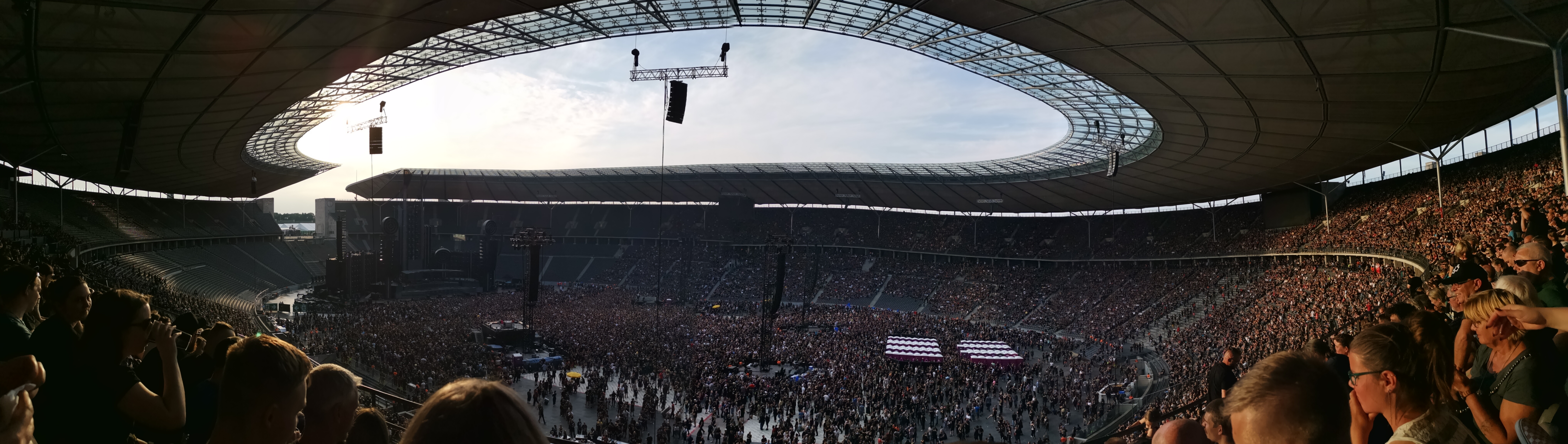
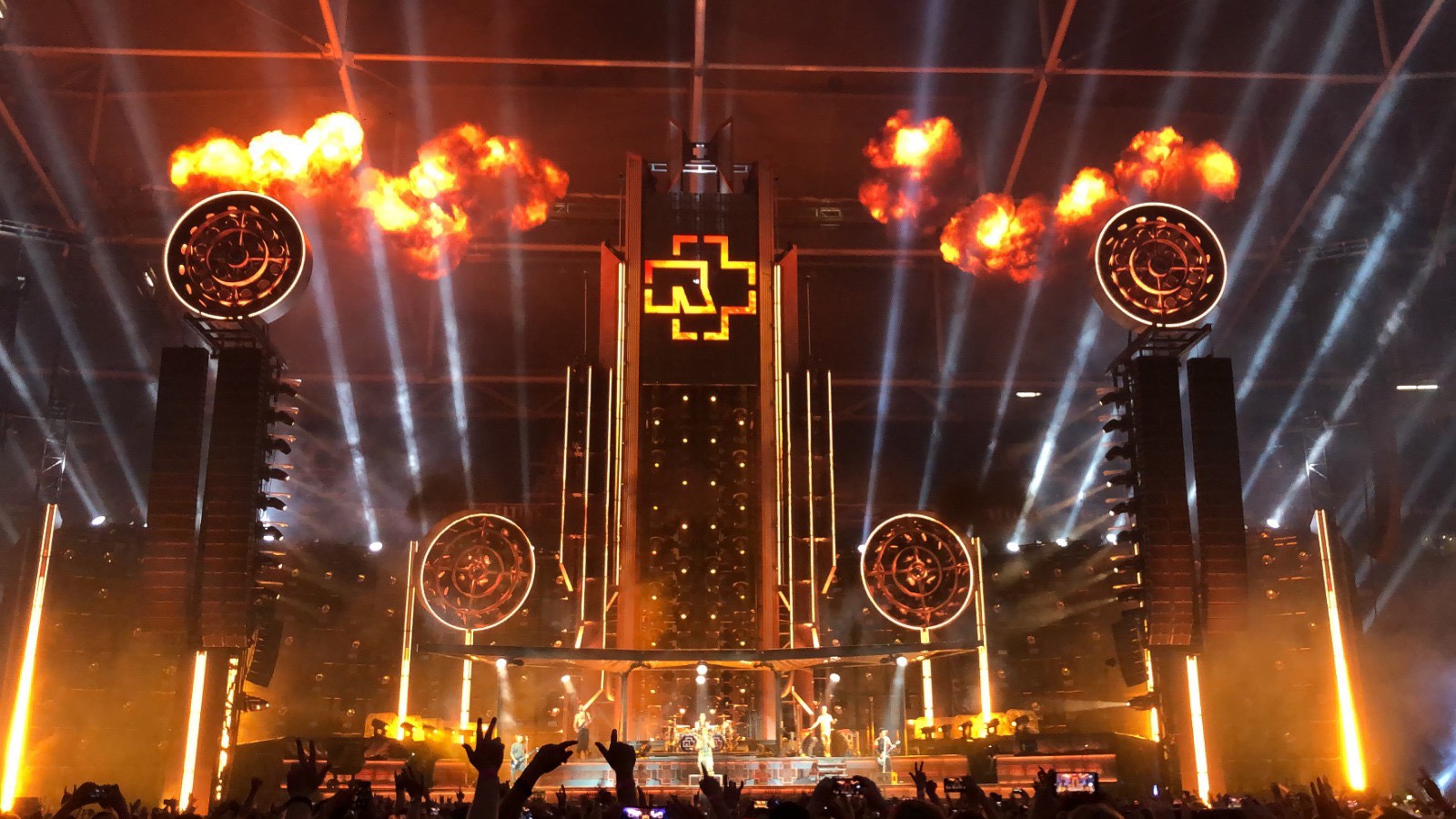
At the start of June, I was in Berlin seeing Rammstein at the Olympic Stadium. It was my sixth time seeing one of my six favourite bands and this was the best I’d seen them. Comfortably, 70,000 plus fans sang every word to every song, including those from new album, Zeit, released only six weeks ago. The fact that so many people had learned a whole new album stands as testament to the band’s ability to construct remarkably memorable songs despite being largely in German. It’s the sheer visceral nature of their music, I think, that hits all those who listen. From Richard Z. Kruspe’s badass razor sharp guitar to Christoph Schneider’s thunderous yet nuanced drumming to Flake’s mad professor keyboards. And, of course, Till Lindemann’s towering presence and volcanic baritone.
In short, Rammstein are elemental much like their own name which literally means ‘ramming stone’ as well being a controversial play on the Ramstein air show disaster from 1988. It’s what they do best. Present as one, can be another, but work equally as both.
And as much as they sound elemental, of course, they use the most destructive one as their main live prop. On this stadium tour, each city visited could easily have been mistaken for having been the epicentre of some terrible disaster. Except, it wasn’t. It was just six mad Germans masterfully mucking around with heaps of fire.
But, I’m not here to discuss their live music. I’m here to discuss the countless hours spent at home and in studios where they honed their sound so they could become the live leviathan they are today.
I won’t be doing a normal ranking. They’re simply lazy, boring and far too easy to do. Instead, I’ll be entitling each one as a reflection on what I believe that album meant in the band’s history.
Here I go.

Herzeleid – 1995. The Intent.
Few bands can claim to have released a first album that sounds like them straight away. That has its own distinct sound and character. Rammstein managed it. Whilst they have influences from the likes of Depeche Mode, KISS, Alice Cooper and Laibach, you can tell they listened to it, took the bits they liked and fused it with whatever they were doing at the time as an enhancment. A bit like cooking a great steak but realising finishing it with a bit of Maldon salt will just add a bit more oomph. They didn’t need to be a new Nine Inch Nails or Marilyn Manson. They already existed. What didn’t exist was a German industrial band that played in ominous tones and sang only in German. That was new and it was exciting.
From the first echo to the initial techno beat followed by the military drums and then, finally, that simple but immensely heavy riff, Wollt Ihr Das Betten Flamen Sehen asked its listeners a peculiar but disturbing question. Do you want to see the bed in flames? Evidently, the answer was a resounding ‘yes’.
The album finished as it started. Dark electronic echos and simple but crushing guitars. Album closer, ‘Rammstein’ is a steady monolith chasing the listener down ever so slowly until they trip, fall and can’t get back up. It doesn’t change rhythm or pitch. It just keeps going. It’s the Terminator made music.
In between, delicious anthems filled the album but amidst those unsettling choruses lay one, sad, lonely, reflective ballad. ‘Seemann’. A song about despair and the wranglings with love, it sits around the middle of the album. A quiet eye in the encircling inferno.
And thus, the Rammstein formula was established. Hate and fury everywhere but a dash of tenderness to break it up and remind you these Teutonic anarchists are human. And yet, it sounds a bit flat. Two-dimensional. Sure, the band have their sound but it was missing something.
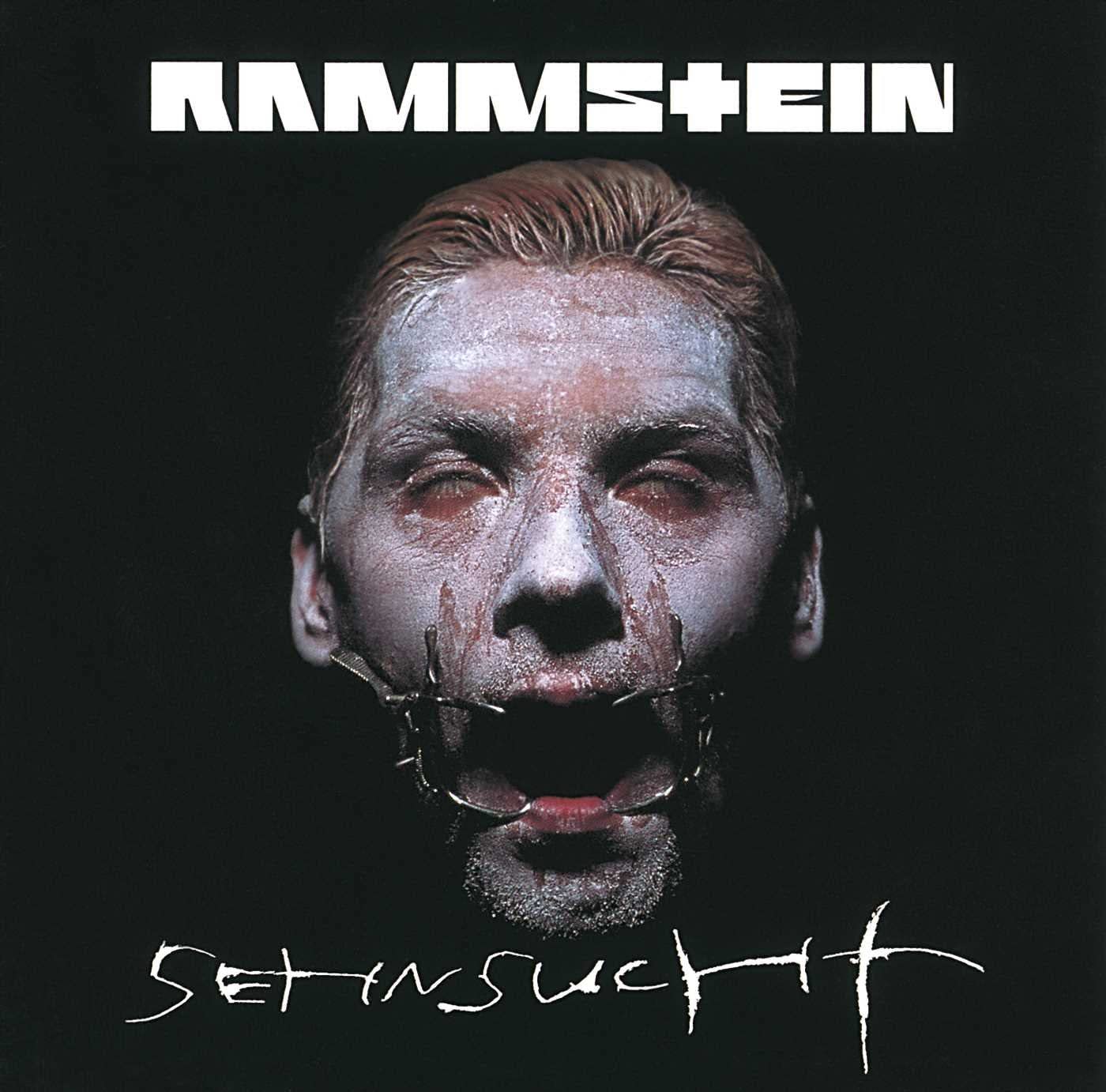
Sehnsucht – 1998. The Promise.
Album two sped things up a bit. The title track, and album opener, hits the ground running at a frantic pace. Till and Flake dash through their vocals and keys like they’d recorded the song on high-powered crack. Either that, or the producer hit fast forward.
Like Herzeleid, just about every song is missing a killer ingredient that would bring them into the third dimension. Whilst ‘Engel’ has been a staple for many years live, its album version lacks the emotional heft the band gave it many years after recording.
In reality, where Herzeleid introduced the world to Rammstein’s brand of noise with no one song standing out, Sehnsucht was all about its hit single, ‘Du Hast’. The song elevated the band to club level where it began to see chart success. But one hit from twenty-two songs isn’t a great ratio unless you’re in pop. ‘Du Hast’ showed that Rammstein were capable of something beyond angry sounding techno metal. But they still needed something.

Mutter – 2001. The Realisation.
Orchestras and Metal have a fairly long history namely because both suit each other so well. They prefer grand, powerful, epic sounds and surreal theatrics that can terrify and excite in equal measure.
And so, the band opted to use a bit of orchestra for their third outing. Not that it compensates for the band. Oh, no. For this album, an orchestra is merely seasoning on a very well executed and delicious meal.
Many bands that get to make a third album go one of four ways: 1 – They fail to come up with anything substantial worth putting out to their audience and consign themselves to oblivion; 2 – They actually create a sound of their own and cease being clones of whoever they were inspired by; 3 – They build on the sound from the previous two albums and reach a critical point; 4 – They keep putting out similar music that degrades in quality with each effort until they are musical husks.
Rammstein are very much Number 3. The sound was there, but it just lacked some depth and gravitas to elevate the band from being cult status to something legendary. The orchestra on opener ‘Mein Herz Brennt’ was inspired. Ominous, foreboding, like stormclouds waiting for the right moment to unleash the thunder and lightning. Till’s voice warped by, to my ears, the use of a gramophone. And then, finally, drums. A full battery of skin-bashing from Christoph Schneider who’d been demoted to the back of an electronic cave on the first two albums where his sound could have easy been one of Flake’s samples. Here, he is very much with the band as are second guitarist, Paul Lander and bassist Oliver Riedel.
The orchestra was not what was missing all along. That’s for the first track. Having all six band members front and centre was key. Another missing ingredient was having songs structured around their live setpiece. Having started out with the intention of using fire as their main stage weapon, the first two albums contained nothing that would translate well with fire. Yes, eventually, ‘Engel’ and ‘Rammstein’ got decent pyro for the stage but ‘Du Hast’ and ‘Du Richt So Gut’ are still played largely using sparklers and fireworks.
It was clear then that, with Mutter, the band had spent a considerable amount of time constructing songs that had their on-stage version in mind. In essence, the fire was baked into songs like ‘Mein Herz Brennt’, ‘Feuer Frei’, ‘Sonne’, etc.
Audience participation seemed to be covered as well. The crowd chorus during ‘Ich Will’, the simple call of ‘Feuer Frei’, ‘Hier kommt die sonne’ during ‘Sonne’ and ‘Links, zwei, drei, vier’ all have crowd-friendly, easy to chant lines that tap into the tribal nature of gig-goers.
Add it all up and you have a fully-formed Rammstein, Harder, darker and faster than ever before.
And yet, there was room for more.

Reise, Reise. – 2004. The Breakout.
Having completed their metamorphosis from cult niche to tour de force, the band needed to up the stakes if they were going to be headliners of the world’s biggest festivals. And nothing says ‘headliner’ like a bit of controversy.
Every great Metal band has done something to achieve a certain level of notoriety. Black Sabbath, though accidentally, had upturned crosses and Ozzy biting the heads off (fake) bats; Judas Priest had whips, chains, leather and a Harley; Iron Maiden had Bruce Dickinson and ‘satanic’ lyrics; Motorhead had Lemmy; Marilyn Manson had the God of Fuck; Cradle of Filth had that t-shirt; Lamb of God’s frontman, Randy Blythe, was incarcerated; Metallica recorded St. Anger.
At this point, Rammstein were just the twisted offspring of KISS, Alice Cooper, AC/DC and Depeche Mode with some fancy flames. They held themselves on a short leash. They had to release the hounds.
And boy, did they.
Lead single ‘Mein Teil’ was about the cannibal, Armin Meiwes, and his internet advert requesting for a volunteer to join him for dinner before being eaten themselves. The song, and accompanying video, are perhaps only slightly less X-rated than the act they were inspired by.
The song’s video got noticed and caused waves in the media and generates some much needed popularity. The song was number one in Spain, number two in Germany and number one on the UK Rock & Metal Chart. It lost out to Slipknot’s ‘Before I Forget’ for Best Metal Performance at the 48th Grammy Awards. Not that it mattered. People now really knew who Rammstein were.
Second single, ‘Amerika’, was a playful poke at our American overlords. It was funny, catchy and had a serious message. Like all good threats delivered with confidence, then.
The two singles were worth paying full price for the album alone. But what we got was, arguably, a band that was a bit more relaxed. One that felt it didn’t quite need to prove itself and so, could take a few more risks. Mutter solidified the fanbase. Reise, Reise allowed some freedom.
Title track and first song is more like a sea shanty but with a dark, Teutonic twist. ‘Dalai Lama’ is a take on Johann Wolfgang von Goethe’s poem, ‘der Erlkönig’. Whilst the content was of the poem, the title is in reference to the Dalai Lama’s dislike of air travel. The song also aroused some controversy with its content as it was also taken to be referring to the Ramstein air disaster upon which the band took inspiration for their name.
Amidst the controversies, the rest of the album was tighter and more focused than Mutter. It did lack a lot of the Industrial feel of its predecessors and leaned more towards Metal. And from that, we got one of the greatest riffs courtesy of ‘Keine Lust’.
Fifth track, ‘Los’, is the first completely acoustic track by the band which they could have performed in a pub or on the street. It just has that wonderful, stripped down feel. Simple strumming, solid bass drum rhythm and some keys at the end. But it’s all to give Till the spotlight.
The album closed with not one, but two ballads. ‘Ohne Dich’ and ‘Amour’. Gentle, relatively speaking, sends offs from an album that showed the world Rammstein were ready for it and weren’t about to apologise for anything they did, have done or will do.
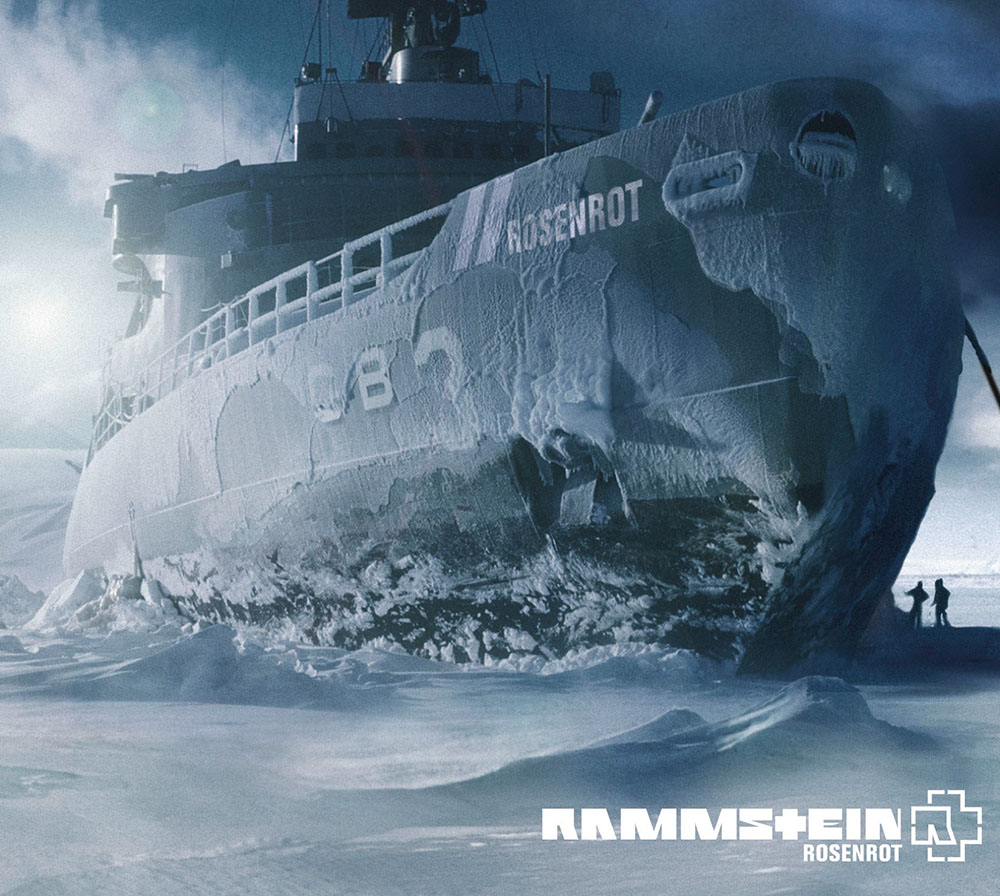
Rosenrot – 2005. The Leftover Misfit.
Having arrived the following year from Reise, Reise, it was clear Rosenrot contained remnants of the sessions of its predecessor. And that meant the choice cuts were removed and what was left were scraps innovatively moulded and shaped to pass as original material.
Rather than build further on the disturbing image they had forged, Rammstein took its first and, so far, only step back.
Unfortunately, there’s nothing on the album that stands out. It’s neither terrible nor magnificent. It’s just solid. Opener ‘Benzin’ lacks the flagrant intent its title suggests. Second track, ‘Mann gegen mann’, attempted controversy by having its video see the band greased up, semi-naked and surrounded by a bunch of fully naked and greased up men pitted against each other in highly homoerotic fashion. Had they done this ten years earlier, it would have given them a boost. But, for album five, this was a step down. Granted, it’s got a strong riff and chantable chorus but they’ve recorded better before and since.
In reality, about half the album is practically ballads. Tracks 2-6 are softer and more tender, particularly ‘Stirb nicht vor mir (Don’t Die Before I Do)’, which features Texas frontwoman, Sharleen Spiteri.
From there, the next three tracks, ‘Zerstoren’, ‘Hilf mir’ and ‘Te quiro puta!’ try to inject some zhuzh back into the proceedings. The former gives tribal drums, Arabic chants and a grunting Till. The middle is all heavy riffs and the latter is a wonderful experiment with a mariachi band that sounds like it could have featured in a Robert Rodriguez shootout sequence over Salma Hayek. It had gravitas, maracas and senoritas. This could have been a lot more fun.
Like Reise, Reise, Rosenrot closes on two slower numbers. ‘Feuer und wasser’ is solemn tale of a man obsessing over a woman that he deems is forbidden to him. ‘Ein lied’, on the other hand, is more of a lullaby or hymn telling the listener that if they lead a good life, they will be treated with song.
Ultimately, the band never gave this album a tour. ‘Benzin’ and ‘Mann gegen mann’ have made it to the stage a few times. As I said before, there’s nothing inherently wrong with this album, but when you’re trying to position yourself as a raging bull of bombastic ambition, having an album half-full of slow numbers and the remaining half lacking in urgency and conviction then you’ve all but taken yourself out of the game.
It also doesn’t help that the band don;t seem fully on board. Till’s baritone growl has all but gone; The guitars of Kruspe and Landers seem dialled down to 8/11; Riedel’s bass is barely noticeable; Schneider’s drumming is competently solid; and Flake’s keyboards don’t to make their usual cool, eccentric impact.
Again, the album is fine on its own. But given this is Rammstein, a bit more rampancy and less reflection was needed. Reflection is for later in the career that’s been built. Not for whilst you’re building it.
One for fans to be listened to indoors in quiet contemplation.
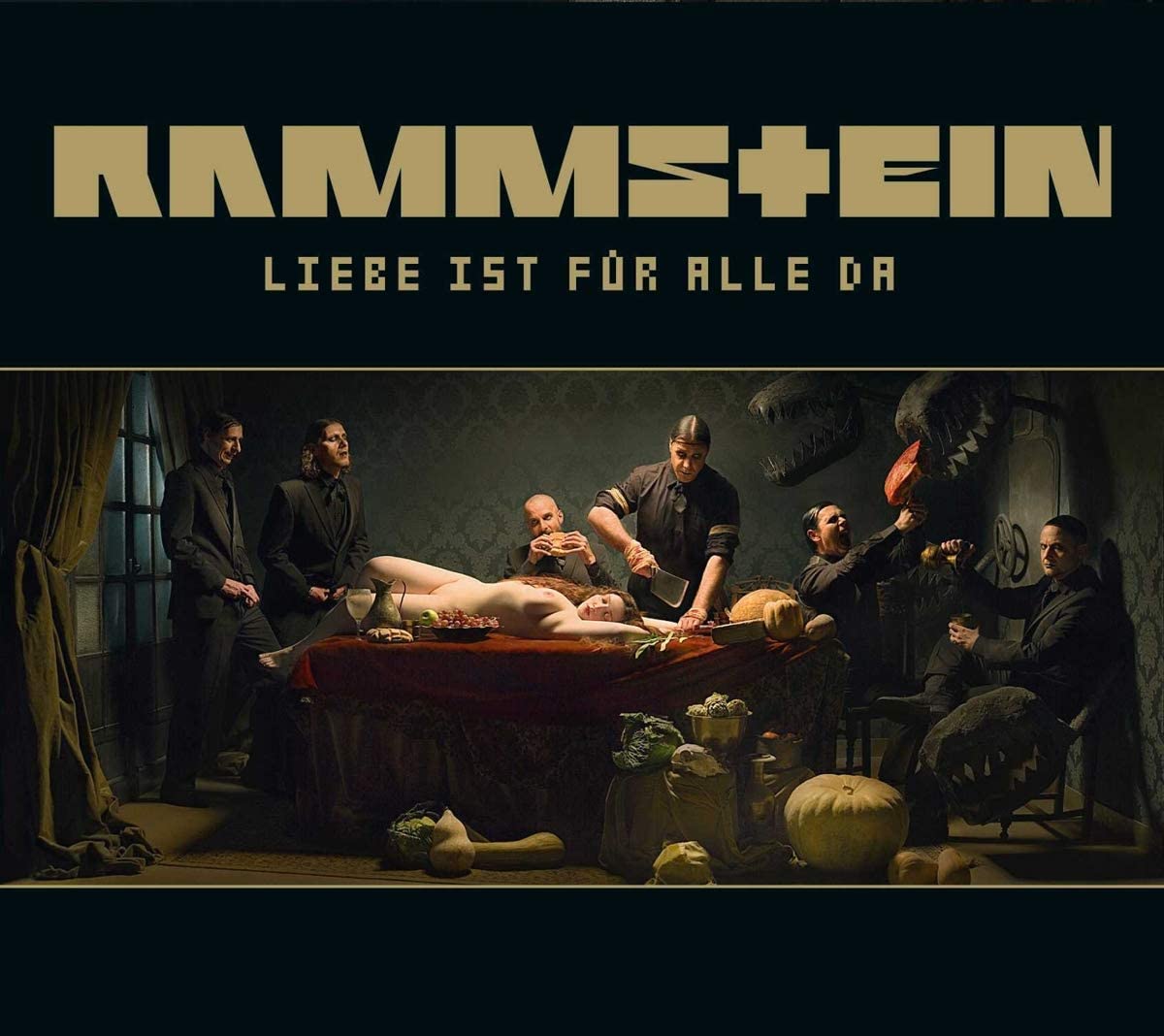
Liebe Ist Fur Alle Da – 2009. The Metal Monster.
Four years after their misstep, Rammstein returned with ‘Liebe Ist Fur Alle Da’. The now giants of Industrial Metal decided that, on this occasion, they’d lean more towards the Metal part of their sub-genre.
And so, we get an opening sample that’s so foggy and atmospheric, it could be Black Metal. Till’s new and improved voice sweeps majestically across the synths. And then – ‘RAMM…STEIN’ called out in symphony to heavily detuned guitars backed by, for the first time, blastbeats and double-kick fills. Definetely more Metal and only thirty seconds in.
It continued. ‘Ich tu dir weh’ and ‘Waidmanns Heil’ showcased Rammstein’s ability to create music for heads to bang by.
And then, as if they could forget, we got ‘Haifisch’. The band, on their heaviest album to date, allowed themselves to go full Depeche Mode for one tune. ‘B********’, or ‘Buckstabu’ could easily be a slowed down Death Metal track, chorus aside.
As is tradition, we get a ballad roughly in the middle; the beautiful ‘Fruhling in Paris’. Referencing Edith Piaf’s iconic ‘Non, je ne regrette rien’, the song tells of a sensual enounter between a younger man and older woman one spring in Paris.
After that little tearjerker, it’s back to disturbing territory with ‘Wiener Blut’. Quiet, unsettling beginning met with crushing guitars and drums. Written like a Brothers Grimm fairytale, it alludes to the horrific crime of Austrian, Josef Fritzl, who kept his daughter locked up in a dungeon between 1984 and 2008 where she was raped a reported 3,000 times and was forced to birth seven children.
The band, naturally, do not tiptoe around the subject matter. Nor should they. They deal with it as we expect. You’d think that, after ‘Mein Teil’, this would be the song to cause controversy. After all, the story broke out the year before and Josef Fritzl was behind bars six months before this album came out.
However, it was the next track, ‘Pussy’, that got the attention. After having had no impact on the sensationalist media with the previous album, the band were making up for lost time and ground. Using a porn site to premiere the video, the band decided to make porno.
Of course, it got a reaction. How could it not when the six members, and their members, are messing around in various states of undress whilst declaring they can’t laid in Germany.
The song itself exploded (scuse me) and with good reason. It’s catchy and it’s about sex. Once again, the band tapped (again, scuse me) into the ancient, tribal part of the brain and provoked a strong emotional response. And who can blame them? If they hadn’t written this song, we’d never have gotten Till riding a penis cannon during the live set.
After Pussy came (honestly) the title track. A frantic drum intro followed by fast riffs and screaming synths. Till tells his story at pace and urgency pushing through the bands’ concentrated cacophony.
Penultimate track, ‘Mehr’, is more open with space for each of the members to perform, bu it’s no less crushing in its execution. The chorus belong to Till and the guitarists whilst the verses are Till and Schneider. Flake floats above the adding dashes of colour where appropriate.
Close, ‘Roter Sand’, is about a tragic affair of two men duelling over a lover after Till’s character caught her cheating. It opens with a quiet, melodic, melancholic whistle that bridges each verse. There are no drums, no bass and no keys. It’s Till, a guitar and a bit of orchestration at the end to accompany the teilling of the sad tale. As a closer to the album, it does serve as a palate cleanser from all the thrashing about the band had been doing throughout. Some grand sorrow to counter the violent anger.
Overall, the album is varied despite being more Metal at its core. The band, I’d argue, were successful in juggling the trouble of both upping their game from Reise, Reise and compensating for Rosenrot.
Live, this album blew people away. Exploding laser-eyed dolls; spotlight serenades; the band hammering through a wall whilst bathed in pure white light; and Till on a penis cannon. Rammstein were back!
Non-Recording Period – 2009 – 2019
And then, they went away. Partially.
At this point, most bands would continue recording into, what I like to call, the ‘experimental phase’. This phase is where bands take what they have learned in their first few releases then start to play around with their sound and see what they come up with.
Rammstein opted not to do this. Usually, this phase yields mixed results with some bands coming out much stronger, whilst others struggle to regain what made them so good before.
What Rammstein chose to do in the intervening decade was work on their live show. In a sense, their ‘experimental phase’ was done on stage with sets and pyro. The only musical output we got during this whole time was the wonderful ‘Ramm4’ which is still due an album release. The official reason for the album hiatus was along the lines of ‘Six captains trying to steer the ship’. If that’s true, then making albums might have been a bad idea.
From having been able to fill venues of less than 10,000 before the studio hiatus, the band went on to fill arenas and headlined festivals. Then, in 2019, they announced themselves as a stadium band and, along with it, a new album. The live experiment was a success in pulling in the crowds. But what about the music that followed?

Untitled/Rammstein – 2019. The Rebirth
Ten years but a lot learned on the road. Now a full-sized stadium band, Rammstein emerged from this metamophosis with a live show far bigger, grander and ambitious than any of their influences or contemporaries. They’d done it.
Except, there was the matter of the new album. What had ten years of playing material from six albums done to the bands creativity? Quite simply, it bolstered it.
The Untitled album is the result of six men all given equal weight in the creative process. Before, maybe half the band was more prominent than the rest. Here, they’ve managed to create music that is respectful to each members discipline. No one is in the background working with lesser material.
Opener, ‘Deutschland’ showcases the band’s newfound ambition for cinematic storytellling. From laser-like keys to purposeful guitars to more thoughtful, but no less impactful, drums. Till’s vocals entered new realms of expression; his baritone now more developed and colourful.
This continues throughout the whole album. Each song is more a story set to music than something designed to fill club dancefloors, start moshpits or sned tingles of shock and excitement throughout the body. Those elements remained, but the band had now gone from kitsch techno-metal through angry fire-breathers through topical antagonists and had reached the realm of the artist. They’d grown beyond their idols and become an entity in their own right. But could they sustain it?
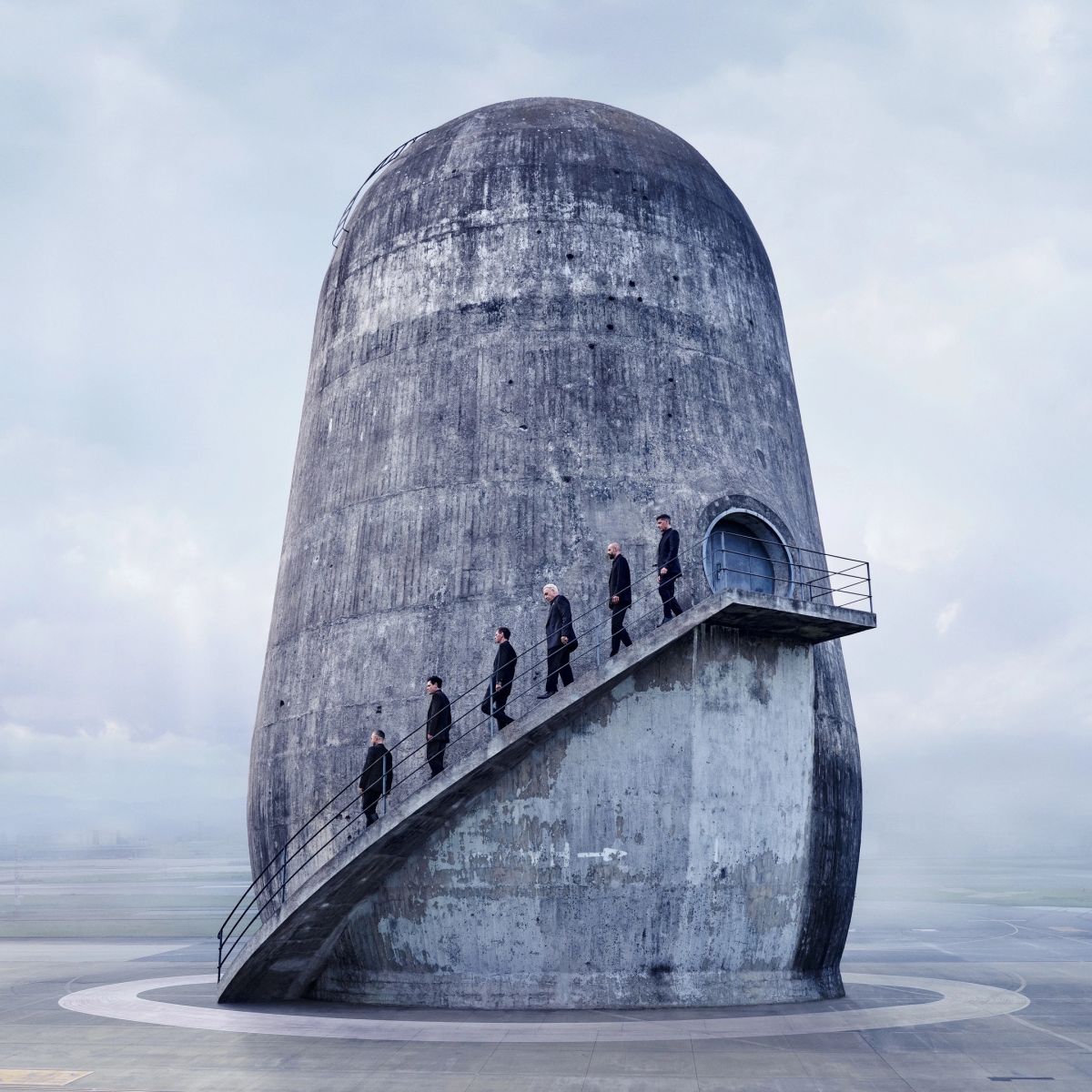
Zeit – 2022. The Reflection.
Lockdown was kind to us creative types. Rammstein, in particular, spent the time wisely working on a new album since karma elected to kick them off the road and into their respective home studios so they could get on with making up for lost time. After the previous album and stadium tour, people were hungrier for Rammstein than ever before.
Choosing to call your eighth album ‘Time’ is a brave choice. It suggests that this could be the final one. Whilst the band have confirmed nothing of the sort, if this turns out to be the case then what a way to go.
Yes, it reflects largely on time and the inescapability of it. Even fun, oompah banger, ‘Dicke Titten’, has a reflective bent on it where all an old man wants from the rest of his time is a wife with big tits.
Opener ‘Armee der Tristen’ is a melancholic poem about people being sad together. And yet, the chorus was sung with as much zest by the Berlin crowd as ‘Pussy’.
Same goes for the title track. There’s an awareness of mortality throughout particularly when the chorus rings ‘Time. Please stop, stop. Time. It should always go on like this. Time. It’s so beautiful, so beautiful. Everyone knows. The perfect moment.’
Third ballad, ‘Schwarz’, continues the melancholia about a lone soul that can only gain pleasure from the night. By the time ‘Giftig’ rolls around, we’re shaken from this fog of beautiful depression and reminded that Rammstein remain a band that can sing about hate and anger. No better reminder than ‘Toxic’. Britney Spears, this is not. A willing victim gives themselves over to an addictive predator. A vampire, perhaps?
‘Zick, Zack’ is a playful number with the usual double meaning. This time, the band reflects on those who stupidly undergo plastic surgery in an attempt to remain youthful.
‘OK’, or ‘Ohne Kondom’ has a great intro, riff and drumbeat for driving. But, given the title, I imagine it’d be good for sex. Need to try that out. In short, this track is about satisfying insatiable BDSM appetites with a prostitute or prostitutes. How very Rammstein.
‘Meine Tranen’ tells the unsettling tale of a grown man living with his mother. In years gone by, this would have been the attention grabber. The one to steal controversial headlines. Instead, the band go the sophisticated route and weave a dark poem telling of the mother’s brutality to her son met with her commands of him to not cry. It’s a sympathetic tale of how boys are conditioned into showing no emotion even when suffering such horrible acts.
‘Angst’ is a topical track. Initially, it’s a father telling his children the ‘Boogie Man’ will get them. Problem is, the Boogie Man is, if you’ve watched the video, represented via the media and the politicians. I had to research this one more as I could hear another fairytale in the lyrics being interwoven with current events. Apparently, this track has roots in the 18th Century German game ‘Black Man’ which itself is rooted to the plague. I can see why the band chose to match such lyrics to the dramtic visuals of the video. It’s harrowing and viral.
From that wake up to reality, ‘Dicke Titten’ is another reminder that Rammstein are carnal animals. All they want is women with big tits.
‘Lugen’ sounds blissful. The first notes are hopeful. Another poem is formed from the lyrics. A person vows to lead an idyllic life no matter what. Except, it’s a lie. Interestingly, Till’s voice is distorted with autotune when he sings the chrous of lies. Again, the theme of time is present. On this occasion, the band presents a dishonest person who is all too aware that their time is running out and the truth will surface.
Finally, we have ‘Adieu’. Fortunately, the lyrics suggest nothing of the band retiring. There’s no coded message to decipher here. We finish on another dark poem. The darkest of all. Death.
Yet, despite being so matter of fact about the most basic of life’s facts, Rammstein end this album triumphantly, defiantly and with that touch of melancholy. You are alone in death but there are those who wait to be with you.
And so, the band come full circle like the cycle of life and death. Time is immortal, as is death, but we are not.
With Zeit, Rammstein have become masters of story, expertly mixing folklore with the present. Past unto present. In real terms, this is a concept album and, for that, it’s more tight, concise and clearly structured than its predecessor.
As for the future, well, the band have said they aren’t stopping. This is good news. More shows, more new music and more time with the Teutonic Titans.
But can anything new match the carefully crafted works of these most recent albums? Time has been kind and rewarded our patience with albums that sit very close to the classic that is Mutter.
Will new ventures meet or exceed what has been created these last three years? Only time, and Rammstein, will tell.
 Thoughtful Meanderings