

The Three Musketeers: Milady
Since we’re about to enter the fourth month of 2024, I thought I’d try and slow time down a bit by going back to December of 2023. I didn’t care much for films last year and, in fact, have barely been to the cinema post-pandemic. The standard of Hollywood’s output has been lacklustre bar Dune – Part One, Top Gun: Maverick and Oppenheimer. Even the typically reliable Mission Impossible franchise’s latest offering, Dead Reckoning: Part One, felt weak compared to its previous entries.
So, I thought I’d give the smaller, less American, productions a chance. First up was The Three Musketeers: Milady. Having seen ‘D’artagnan’ at the start of the year, I was cautiously curious as to how the story would wrap up. After all, this was the first French adaptation in over 60 years. Surely, the French, so protective over their history and culture, wouldn’t mess too much with Alexandre Dumas’ classic?
I’m afraid they did. ‘D’artagnan’ took the popular tale and failed to make it exciting. The innovative camera work (where it looked like the camera dolly didn’t track the action accurately enough and so caused a delay in what the viewer saw on-screen) just looked sloppy and confusing whilst the actors were too old for their characters. The political intrigue, espionage, courtroom drama, threat of war and camaraderie between the four men were given lip service.
‘Milady’ continues this. We have Eva Green, best known for being a Femme Fatale, playing, arguably, the original Femme Fatale and yet she comes across as a rank amateur. Within the film, it’s made clear she’s been doing Cardinal Richlieu’s work for some years and yet, she has about all the seductive prowess as a nervous teenage girl and all the subtle stealth capabilities of a neon sign. And whilst this second part is dedicated to Milady De Winter, we learn little to nothing of her and her relationship with Aramis nor do we get her seducing D’artagnan leading to him being conflicted over defending King and Country, his duty to his Brothers in Arms versus his growing feelings for a temptress that seeks to manipulate him for her own means.
Green does the best she can with what’s she’s been given which is not much. We see a woefully inept and desperate assassination attempt on the Duke of Buckingham at close quarters. This version of the Duke, black in keeping with ‘The Message’, is three times the size of Green’s Milady yet, for no reason within the context of the film, decides she’s going to walk up to him, pull out a pistol and try to shoot him there and then. Quick with his wits, the Duke promptly slams her head into the table. I honestly don’t know what the writers thought when putting that together but it just makes one of the most cunning, sinister and tragic characters in literature look horribly incompetent.
And yet, near the end of the film the audience is also expected to believe a physically and emotional wounded Milady can hold her own against the fully trained Musketeer of D’artagnan in a burning stable. Again, she could have used her feminine wiles to get his guard down, use her vulnerabilities to curry sympathy, weaponise his feelings for her then stab him in the shoulder or something.
Nope. She just gets on with the sword fight. Something we didn’t see any evidence of in the prior film, but we are expected to believe that she has the strength and skill to fight a grown man whilst sporting an injury and being starved of oxygen. I tend to struggle when a film nowadays pits men and women against each on equal terms as if to say that, secretly, women have similar upper body strength to men. Or even more.
Politics aside, I go back to my earlier point. This part is subtitled ‘Milady’ but we learn little about her. If anything, this is more Aramis’ film than anybody’s. The Three Musketeers and their relationship with D’artagnan is not forged; the relationship between France and England is not given its correct weight; the deceitful and treasonous acts of Richelieu are made trivial.
What the director, Martin Bourboulon, does instead is cast these huge aspects of the book and previous adaptations aside in favour of a revenge story between Milady and Aramis. Although, ultimately, the story panders to the feminist narrative that women are not bad, but they are made bad by men. In this version, Milady is seen in a flashback being abused as a young woman. Aramis’ crime? He took her away and gave her a home and a family, but she decided to run back to her abusive past except, this time, it would mean becoming a traitorous spy. I suppose the feminists would say Milady was ‘forced’ into an ‘oppressive’ life where she had to have a child and was denied her freedom and that her escape was her merely being her ‘true self’. I suspect that nonsense was discussed in the writer’s room because there was very little in the way of engaging characters or plot here. Even if all they had to do was take it from the book!
And as messy as it started, messy is how it ended. Instead of getting a conclusion, the film’s climax is a cliff-hanger with Milady stealing her son from Aramis’ estate. Initially, I thought, ‘Hold on. How can it just end when this is supposed to be the end?’. It turns out that Pathe are looking to expand out into TV to tie things up. Given the small budget this had and its poor box office returns, I doubt anyone will green light a TV series.
I had high hopes when the very first trailer dropped. A French adaptation of a French classic novel (a favourite since childhood) filmed in France, using French actors and spoken in French. I honestly believed it could not fail. How wrong I was.

Godzilla: Minus One
So, I had an all French production and the second of these three is all Japanese. Again, another childhood favourite, Hollywood’s treatment of Gojira has lacked the mystery and honour of the fabled creature. Instead, it’s been portrayed as another big monster.
So, like with the full French Musketeers, I had high hopes for this full Japanese version. Certainly, in my lifetime, every iteration that’s ended up on UK screens has been American so I was curious to see how the Japanese did it.
Well, unlike the French, they did not dishonour one of their most beloved stories. In fact, this has been one of the most enthralling and captivating films I’ve seen in a very long time. Where Hollywood tends to fill out the plot with stupidly pointless human subplots, Minus One fully merges the story and Man and Monster.
We are introduced to Shikishima, a failed Kamikaze pilot who is disgraced by his town for not doing his job. That job involved him being on Odo Island where the military operation he was part of was laid to waste by the giant monster, Godzilla. He comes across a young woman, Sumiko, and her baby. He takes them in and we see the beautiful blossoming of a potential family, however, despite her obvious feelings for him, Shikishima is weighed down by guilt of having survived and seeks revenge on the monster. From there, we see a rogue group of men being gathered to come up with a way to bring down the very apparent threat of Godzilla.
And, unlike Hollywood, the director, Takashi Yamazaki, knows exactly how much of Godzilla to show and when. And what an unnatural force this creature is. Not only is it truly monstrous, but it’s clever too. Able to take everything the humans throw at it and forcing them to come up with a truly innovative way to take it down, if anything, out of sheer desperation to survive.
Amidst the terror, we get the very human love story of Shikishima and Sumiko where the former’s desire to fulfil his honour and get revenge pushes the latter to the breaking point. Even when Sumiko saves Shikishima, during an early attack from Godzilla, and ends up hospitalised, he will not admit his feelings for her as the film makes it clear that he cannot be allowed to given he failed his country.
And so, the film seamlessly builds towards this ingenious method of taking down Godzilla whereby a team of boats, led by Shikishima in an experimental Kamikaze plane (filled with explosives and no ejector seat), would carry a large net held together by a series of explosive packages. However, attached to these explosives would be inflatables. Why? The plan was to fire the explosives which would drag Godzilla down to the bottom of the ocean fast causing his body to not only suffer extreme pressure changes, but temperature changes to. Once dragged down, they’d fire the inflatables to bring him back up just as fast as he went down with the hope being that the extreme depressurisation would be too much for his body and he’d die.
The plan kind of worked. Until Godzilla didn’t die. Enter Shikishima and his opportunity to complete his task. He distracts Godzilla with strategically timed bullet fire then waits for the monster to power up before flying the explosives-rigged plan into the throat of Godzilla sending it back down to the depths of the ocean.
Everyone is shocked. No one wanted Shikishima to actually fulfil his country’s duty, least of all Sumiko, and kill himself even if it ultimately meant defeating Godzilla.
And you are left lingering for a few moments thinking that Shikishima, who had been building up to his revenge all film long despite having others around him that wanted him to live, had been such an arrogant, or righteous, fool and actually sacrificed himself almost out of spite.
Fortunately, he did not die because, after all, an ejection mechanism had been built into the plane. The group are overjoyed that everyone made it out of the ordeal and we get a truly heart-warming reunion when Sumiko is given the news that Shikishima had died only for him to walk in knowing she was the reason he didn’t go through with it. It had me with a lump in my throat and a few threats of tears.
Of course, Godzilla did not die. He was merely set back a bit, but it means we can get at least another film of this calibre by Toho Studios because it was a remarkable achievement given it cost a measly $15million to make and grossed just short of $111million worldwide. Truly astounding and far, far better than a lot of Hollywood’s recent efforts where the budget is at least another $40million over the gross of Godzilla Minus One yet here, the cast and crew delivered a film that was not only jaw-dropping and heart-stopping but poignant and intimate and with an insight into a little bit of Japanese culture many here in the West are left ignorant too. The best of the December trio for me.
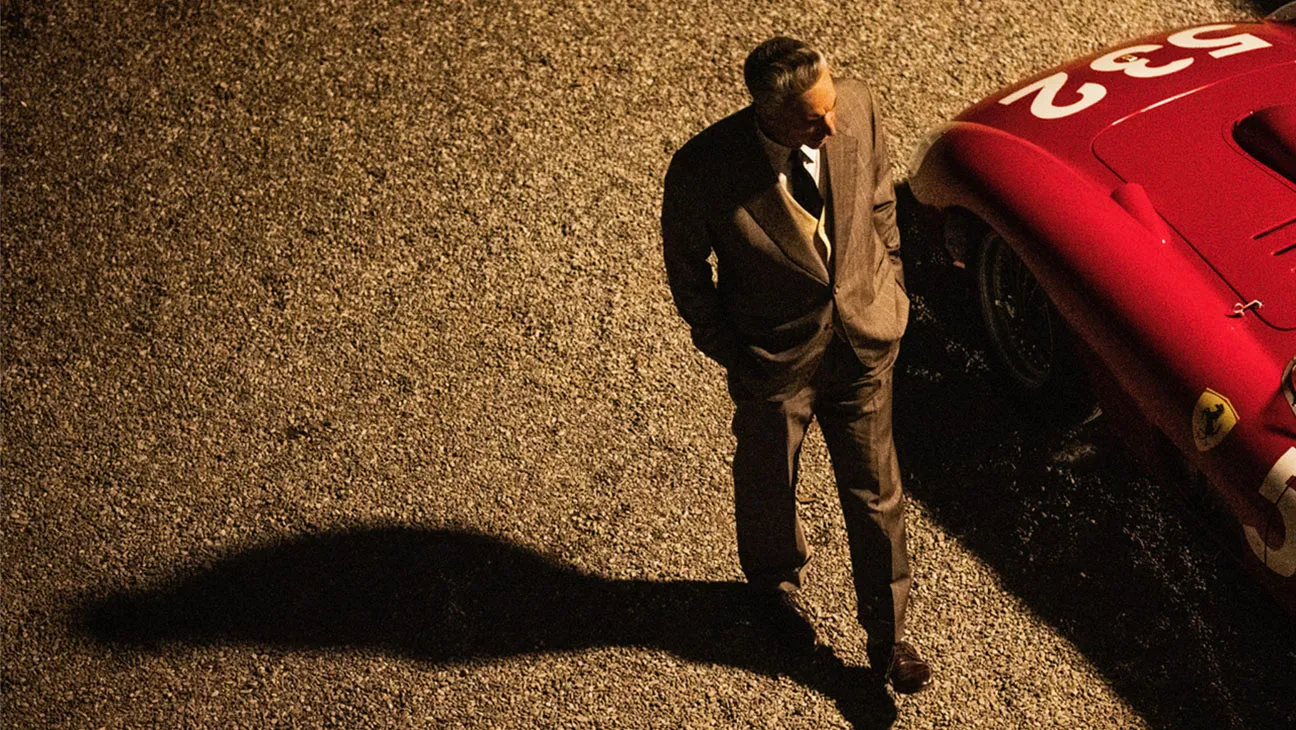
Ferrari
Two great leads in Adam Driver and Penelope Cruz; a story about the founder of, arguably, the most recognisable car brand in the world; a budget of $110million; and a director whose last decent film was 2009’s ‘Public Enemies’.
Spot the weak link.
Michael Mann is one of those cult directors that has some sort of mythical status in Hollywood. It’s almost as though his films are so nuanced that it takes only a true auteur of cinema to truly appreciate the mastery at work. In reality, his films are hit and miss. He’s America’s answer to Ridley Scott although he’s not managed to put out anything as epic as Gladiator or as horrifically genre-defining as Alien.
With Ferrari, he tackles a man so legendary in the car and motorsport world that the company have not deviated much from their founder’s ethos – To design the perfect car as a testament to performance, design and emotional allure.
Indeed, early in the film we are shown a glimpse of this when Enzo is at the kitchen table of his mistress/second wife, Lina Lardi, where he is drawing the layout of an engine. He tells his son, Piero, that “When a thing works better, usually it is more beautiful to the eye.'”
And certainly, Mann shows us this in how Ferrari operates. Beautiful clothes, beautiful cars, beautiful drivers, beautiful women, the list goes on. Everything and everyone Ferrari surrounded himself with operated slickly for good or for ill. Our introduction to his wife, Laura, played wonderfully by Penelope Cruz, shows how passionate and savagely loyal she is when she intentionally misses him after unloading a few rounds of her pistol into a wall. And all because he was late.
For car fans like myself, the film shows more of the family man which we don’t get to hear or read about as it’s always the engineering, racing and business aspects we get.
However, we don’t get enough. We don’t get the more on the intimate details and how they effected Ferrari. Far car fans, we know that the Dino was dedicated to his son after his untimely death. We also know it was never badged a Ferrari despite being made at the Ferrari factory, but we don’t get more on why and the film never gives us an explanation. Maybe no one knows and the truth died with Enzo.
We also don’t get anything on why the relationship between Enzo and Laura broke down. Was it the death of Dino? Was it Enzo’s drive for motoring perfection? Was it Enzo’s need to make a stamp on the world? Again, Mann offers nothing and neither do we get any context as to why he has a secret second family. For a man of such standing to have another family, which he pays for, and have them kept under the radar is not strictly unusual, but there would normally be a very good reason. It’s implied that Laura no longer wanted or could no longer have children after Dino’s death but it’s not made clear nor is it made clear that Enzo desperately wanted a full family and an heir to his legacy. It seems that Mann forgot these elements which would have strung the emotional plot together in a far more cohesive manner and been more effective for it.
And this lack of cohesion spreads to the racing and business side of the plot. We have Ferrari’s company under threat of closure due to poor sales. His options are to sell to Ford or Fiat or win the Mille Miglia and get the coverage required to boost orders and keep the sales coming in. What we don’t get is how these options affected him.
We see the arrogant, driven and passionate man when it comes to his company. But only glimpses. I particularly enjoyed Driver’s delivery of Ferrari’s razor-sharp wit and keen enthusiasm when it came to seizing opportunities to make headlines. But, again, those more in the know will understand that this was more a performance to keep the media and his competitors at bay. Unfortunately, the film shows little of how the man operated behind closed doors. We mostly see what he’s like in public which is rarely a true reflection of anyone whose in the public eye.
And so, what to make of Ferrari? Well, if it were made for television at a tenth of the budget, I’d say it’s a perfectly decent way to kill a couple of hours on a Sunday afternoon. But for a big budget biopic with two big leads and a big director? This is mediocre. It looks and feels like a TV drama because it is. The limited CGI used is horrific (see Godzilla Minus One on how to create rather exceptional CGI on a small budget) and the plot has no idea whether it should focus on the family drama, the corporate drama or the racing drama. It could have successfully merged all three as all three come from the same man so the plot should have spiralled outward showing the interconnection to Enzo Ferrari, the man. Instead, it meanders across them and gives no depth to either.
When the trailer says ‘From the Director of Heat and Last of the Mohicans’, both made in 1995 and 1992 respectively, you know you’re in a spot of bother since those are really Mann’s two ‘classic’ films only films of note. Everything else has been alright to decent. Nothing outstanding, but nothing terrible either. And ‘Ferrari’ is the same which is not befitting of a man who gave so much to his chosen field and whose company continues to pioneer and innovate on the road and the racetrack.
Which is a shame as 2023 could have been the year of the blockbuster biopic with ‘Oppenheimer’ getting accolades across the board, ‘Ferrari’ too could have achieved something similar, albeit on a smaller scale, had it been made by a director more comfortable and familiar with the history. I have no qualms with the cast. The two leads give compelling performances though I’d question Driver’s Italian accent, but, otherwise, he was fine. I can’t see another actor doing wildly better with the script. For Cruz, whilst her screen time was limited, she put a lot of fire in her portrayal of Laura Ferrari. But, being Romantic herself, switching from her native Spain to Italy wouldn’t be much of a stretch.
For the purposes of using up two hours on a quiet Boxing Day afternoon, ‘Ferrari’ is, unfortunately, a film you can watch to ease your brain into winding down after a hectic Christmas Day. Which, really, is not what the film should be for.
 Thoughtful Meanderings